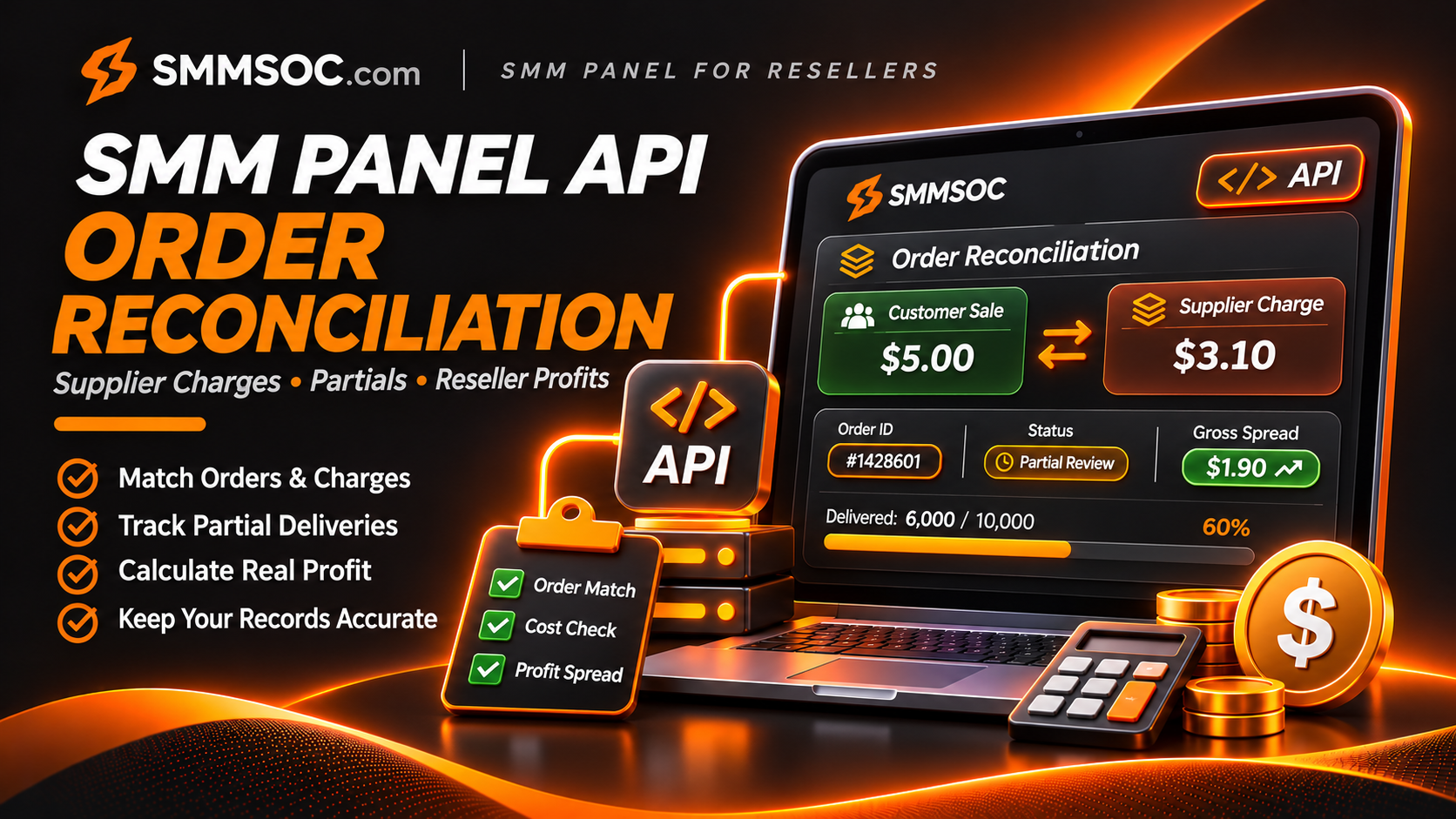
SMM Panel API Order Reconciliation: Track Supplier Charges & Reseller Profits with SMMSOC
A reseller can receive a customer payment, submit an order to its supplier, and receive a successful API response—all without knowing whether its financial records will match when the order is finished.
The problem becomes more complicated when an order is partially fulfilled, an API response is lost, or a supplier charge differs from the amount originally estimated.
For an established SMM reseller, these differences can affect profitability, customer account balances, and support decisions.
SMM panel API order reconciliation is the process of matching customer transactions with supplier orders, reported charges, and verified adjustments.
SMMSOC provides a documented reseller API that exposes order identifiers, status information, charges, remaining quantities, currencies, and account balance data.
These fields provide useful inputs for a reseller's own reconciliation workflow.
This guide explains how to use that information to maintain clearer records, identify discrepancies, and avoid treating estimated profits or unconfirmed refunds as final financial results.
What Is SMM Panel Order Reconciliation?
Order reconciliation means comparing the financial and operational information recorded in two different systems.
For an SMM reseller, those systems are usually:
The reseller storefront: The website where customers place orders, pay retail prices, and view their account activity.
The upstream SMM provider: The supplier that receives supported orders and records the supplier-side charges and statuses.
These systems do not necessarily use the same order numbers or prices.
A customer might pay $5.00 to the reseller for an eligible service, while the supplier records a $3.10 charge.
The difference is not automatically the reseller's final profit.
Payment fees, refunds, supplier adjustments, currency conversion, and other costs may still affect the financial result.
The purpose of reconciliation is to establish what was quoted, what was accepted, what the provider reported, and which adjustments have actually been confirmed.
Why Financial Reconciliation Matters for SMM Resellers
Many resellers initially focus on supplier pricing.
They compare rates, set a retail markup, and calculate how much each order should earn.
That is an important starting point, but the expected result and the actual recorded result can differ.
Supplier Prices Can Change
A service's current wholesale rate may not be identical to the rate used when the customer originally received a quotation.
The reseller should preserve the agreed customer price and the supplier cost associated with the actual transaction.
Orders Can End With Different Outcomes
An accepted order can later be reported as Completed, Partial, Canceled, or another supported status.
These outcomes may have different implications for customer communication and financial settlement.
Provider Charges and Customer Sales Are Separate
The SMMSOC API reports supplier-side information.
It does not know the retail price that another business charged its own customer.
That retail amount belongs in the reseller's internal records.
API Responses Can Be Incomplete or Uncertain
A lost response or connection timeout may leave an order's submission result unclear.
Without proper records, the reseller may struggle to determine whether the supplier accepted the transaction.
Account Balance Changes Do Not Explain Every Transaction
A provider wallet balance can change because of orders, deposits, credits, and other account activity.
A balance snapshot alone is not a detailed transaction statement.
For these reasons, businesses processing substantial order volumes benefit from a structured reconciliation process.
How SMMSOC Supports Order Reconciliation Through Its API
SMMSOC provides a documented API endpoint:
https://smmsoc.com/api/v2
The published interface uses HTTP POST requests, API-key authentication, and JSON responses.
Several documented operations are relevant to order reconciliation.
services retrieves published supplier service information, including rates and quantity limits.
add creates a supported order and can return the supplier order ID.
status retrieves the available information about an existing order.
balance retrieves the account's reported balance and currency.
SMMSOC also documents supported refill and cancellation request operations, subject to service-specific conditions.
Together, these functions allow compatible reseller software to obtain important supplier-side records.
However, SMMSOC's published API does not establish a complete accounting or general-ledger system for another reseller's business.
The reseller must maintain its own financial database and reconciliation rules.
For technical specifications, consult the SMMSOC API documentation.
SMMSOC API Fields for Financial Reconciliation
The following table identifies useful information available through documented SMMSOC API operations.
SMMSOC API Data-to-Ledger Mapping
Fields come from the documented SMMSOC API. The rightmost column describes recommended reseller-side records, not additional fields guaranteed by SMMSOC.
The table also highlights an important distinction.
A supplier's charge field is not the same as a customer's retail payment.
Similarly, the balance response should not be treated as the final accounting record for every individual order.
An effective reseller application connects these values with its own transaction history.
Keep Customer and Supplier Order IDs Separate
One of the most important reconciliation practices is preserving both order references.
Suppose a hypothetical customer order has an internal ID of 84051.
The reseller sends a supported request to SMMSOC through its backend.
If SMMSOC accepts the order, the API may return a different identifier.
The reseller should save that supplier identifier next to the existing customer reference.
Why Two Identifiers Are Necessary
The customer-facing order ID is useful for invoices, support tickets, and account history.
The supplier order ID is used when requesting the order's current status from SMMSOC.
Without an accurate mapping, the reseller may associate a supplier charge or status with the wrong customer.
What to Store When an Order Is Accepted
A practical internal record includes:
- Customer order ID
- Supplier order ID
- SMMSOC service ID
- Destination reference
- Requested quantity
- Customer selling price
- Estimated supplier cost
- Submission timestamp
- Current provider status
- Last successful status check
Store only information necessary for operating and supporting the transaction.
API keys must remain protected on the server and should not be written into ordinary order logs.
Understanding SMMSOC's Order Charge Field
The documented SMMSOC status response includes a charge value.
For example, the API documentation shows the following sample fields:
- Charge:
0.27819 - Status:
Partial - Remaining quantity:
157 - Currency:
USD
These are documentation examples, not a live customer transaction.
The example demonstrates that the API can provide a supplier charge and a partial-order status in the same response.
However, it does not prove that a refund was issued, that the charge is final, or that a particular adjustment rule applies to every service.
Quoted Cost vs. Reported Charge
When a reseller prepares a transaction, it may calculate an expected supplier cost using the published rate.
That estimate helps determine whether the retail price is appropriate.
After the supplier accepts the order, the reseller can obtain the actual reported charge.
These two amounts should be compared.
If the values differ, the application should record the discrepancy rather than silently replacing the original quotation.
Why Status Matters
A charge reported while an order is still being processed should not automatically be treated as the final settled cost.
An order may undergo later status changes or approved adjustments.
For financial reporting, preserve the relevant history and verify the current outcome before finalizing the transaction.
Worked Example: Customer Sale vs. Supplier Charge
Consider a hypothetical reseller order.
The customer pays $5.00.
The supplier reports an order charge of $3.10.
At first glance:
$5.00 − $3.10 = $1.90
That $1.90 is the provisional difference between the customer sale and the reported supplier charge.
It is not necessarily the final profit.
Scenario A: No Further Adjustments
Assume the order reaches an eligible final state and the confirmed supplier charge remains $3.10.
Also assume the customer sale is unchanged and there are no applicable refunds.
The gross spread would be $1.90 before payment fees, taxes, operating costs, and other expenses.
Scenario B: The Order Is Partial
Now suppose the supplier reports a Partial status.
The reseller should investigate the actual outcome and applicable service conditions.
It should not immediately assume that the original supplier charge has been refunded in full, or that a particular portion has automatically returned to the account.
If a customer adjustment is required, the reseller must determine the appropriate amount according to its own customer terms and the verified supplier outcome.
Scenario C: Adjustments Are Confirmed
For illustration, suppose the reseller confirms a $2.00 customer credit and a final net supplier cost of $1.70.
The retained customer revenue would be:
$5.00 − $2.00 = $3.00
The resulting gross spread would be:
$3.00 − $1.70 = $1.30
These amounts are hypothetical. They are not evidence that SMMSOC issues refunds using this formula.
The example demonstrates why both customer-side adjustments and supplier-side charges must be recorded before determining the final financial result.
How to Reconcile Partial Orders Correctly
Partial orders deserve particular attention because the original requested quantity and the reported result may differ.
A reseller should not automatically treat a Partial status as Completed.
Nor should it assume that every provider uses an identical refund policy.
Step 1: Retrieve the Current Status
Use the documented SMMSOC status operation with the accepted supplier order ID.
Read the returned status, charge, remaining quantity, and currency.
Step 2: Compare With the Original Order
Review the customer's original quantity, the chosen service, the recorded supplier reference, and the agreed retail charge.
Keep the original order details intact.
Step 3: Review the Supplier's Conditions
Determine whether the service offers an applicable adjustment, refund, refill, or cancellation mechanism.
An available API operation is not proof that a particular request is eligible or has been approved.
Step 4: Verify Financial Adjustments
If the provider confirms a credit or another adjustment, record the actual amount and supporting reference.
Do not derive a confirmed supplier refund solely from the remains field.
Step 5: Apply the Customer-Side Decision
The reseller must handle its own customer adjustment according to the customer's agreement and the verified transaction outcome.
A supplier credit and a customer credit are separate accounting events.
Step 6: Close the Reconciliation Record
Mark the transaction reconciled only when the required financial and operational checks are complete.
Preserve the history of adjustments for future support requests.
For general status definitions, see the SMMSOC Order Status Guide.
Reconciliation Exception Matrix for Reseller Operations
Not every order requires manual intervention.
A well-designed reseller backend can identify which transactions need additional attention.
Reseller Reconciliation Exception Matrix
These are recommended internal investigation rules, not official SMMSOC status categories.
A separate exception queue makes it easier for reseller staff to identify transactions needing review.
It can also prevent the same issue from being handled by multiple operators without a consistent record.
Using Batch Status Requests to Reconcile Multiple Orders
SMMSOC documents an API function for retrieving the statuses of multiple existing orders.
The relevant request uses:
action=status
Alongside:
orders=ID1,ID2,ID3
The documented limit is up to 100 comma-separated order IDs per request.
This can be useful for existing resellers managing many accepted supplier orders.
Why Batch Reconciliation Helps
Instead of performing a separate status request for every order, compatible software can retrieve several results in one operation.
The response can then be matched with the reseller's own order records.
However, a successful batch request does not guarantee that every included order ID is valid.
The documentation includes examples where one order returns its status while another returns an error.
Process Each Result Independently
A reseller should inspect each returned order entry.
For a valid record, update the corresponding internal order.
For an incorrect or unresolved identifier, preserve the original information and flag the entry for investigation.
Do not mark the entire batch as failed merely because one ID is invalid.
Likewise, never mark every order as Completed simply because the batch HTTP request succeeded.
Batch Status Is Not Batch Order Creation
The documented 100-ID capability applies to status retrieval.
It should not be described as an API function for creating 100 new orders in one request.
For businesses comparing manual and bulk workflows, refer to the SMMSOC API Integration Guide.
Why Supplier Balance Does Not Equal Reseller Profit
SMMSOC's API includes a balance operation.
It returns the provider account's reported balance and currency.
This is useful for evaluating available supplier credit.
However, the supplier account balance does not represent the reseller's total business profit.
Consider an agency that has customer revenue in one system and prepaid supplier credit in another.
The agency may have a healthy supplier balance while also owing customer credits or carrying other expenses.
Conversely, a low supplier balance may reflect a recent funding cycle rather than a business loss.
How to Use Balance Information Properly
Record balance readings with timestamps.
Compare them with known funding operations and relevant supplier transactions.
If the balance changes unexpectedly, investigate the difference.
A simple before-and-after balance comparison is not conclusive when other orders or deposits may have occurred during the same period.
For a separate explanation of maintaining sufficient supplier credit, see the SMMSOC API documentation and its documented balance operation.
Prevent Duplicate Financial Records
A reseller may have processes that update balances, issue customer credits, and save settlement results.
These processes should not create repeated financial entries for the same confirmed event.
For example, if a valid supplier status is retrieved twice, the application should not issue two customer refunds merely because it received the same information again.
Use Unique Internal References
Maintain a unique internal identifier for each order and each financial adjustment.
Store the supplier order ID when available.
Separate Status Updates From Financial Adjustments
Receiving the same status again should update the order record only when necessary.
It should not automatically duplicate a previously recorded refund or charge.
Mark Uncertain Submissions for Review
A timeout during order creation does not prove the supplier rejected the request.
Avoid blindly submitting the same paid request again.
SMMSOC's published API documentation does not establish a native idempotency key for order creation, so the reseller should implement its own internal safeguards and reconciliation process.
Keep an Audit Trail
Record who approved an adjustment, when it was made, and which verified transaction supported it.
This helps explain discrepancies to customers and internal support staff.
How to Calculate Actual Reseller Profit More Accurately
A reseller's initial price markup is not the same as its final net profit.
A simplified financial model is:
Gross spread = Net retained customer revenue − Confirmed net supplier cost
Net retained customer revenue is the amount remaining after applicable customer credits or refunds.
Confirmed net supplier cost is the supplier expense after verified adjustments.
This gross spread does not include every operating expense.
For a broader profitability calculation, consider payment-processing fees, currency conversion, infrastructure, support costs, taxes, and other expenses.
Why Historical Rates Matter
The rate available when the customer placed an order may differ from the rate shown later.
Keep the original quoted supplier rate and the actual transaction charge.
This allows the business to distinguish pricing changes from other discrepancies.
Why Currency Matters
SMMSOC's status and balance responses include a currency field.
If the reseller charges customers in a different currency, the business must record the exchange rate and any applicable conversion costs.
Do not compare amounts denominated in different currencies as though they were directly equivalent.
Why Final Settlement Matters
Some orders remain unresolved for a period of time.
An accurate system distinguishes provisional estimates from confirmed financial results.
This avoids overstating profit while refunds, cancellations, or other adjustments remain under review.
A Practical Reconciliation Workflow for SMMSOC Resellers
An existing reseller backend can organize financial reconciliation around several repeatable steps.
First, record the customer transaction. Save the agreed amount, currency, internal order number, and relevant payment information.
Second, preserve the supplier request. Record the SMMSOC service ID, intended quantity, expected supplier cost, and submission timestamp.
Third, save the supplier order ID. If the API accepts the order, link the returned identifier to the customer record.
Fourth, retrieve status information. Use the appropriate documented status operation to obtain current supplier information.
Fifth, compare charges and outcomes. Review the reported charge, status, remaining quantity, and currency.
Sixth, flag discrepancies. Investigate missing references, unexpected charges, partial orders, and unresolved cancellations.
Seventh, record verified adjustments. Separate provider-side credits from customer-facing refunds or account credits.
Finally, settle the internal transaction. Close the reconciliation only when the required checks and financial adjustments have been completed.
This workflow is designed for reseller software that integrates with SMMSOC. It is not presented as an automatic accounting feature enabled by default on SMMSOC accounts.
Why Consider SMMSOC as an API Provider?
For an existing SMM reseller, a supplier relationship involves much more than obtaining access to service prices.
A reseller also needs information that can support financial planning, customer support, and accurate order tracking.
SMMSOC offers a multi-platform service catalog and a documented API with several relevant functions:
- Service information and published pricing
- Supplier order creation
- Individual order status retrieval
- Multiple-order status requests
- Reported order charges
- Account balance checks
- Supported refill and cancellation operations
These capabilities allow compatible reseller applications to retrieve supplier-side information and connect it with their own business records.
For teams managing many orders, that information can provide a foundation for better administrative visibility.
The actual financial controls, accounting reports, and automated adjustments remain the responsibility of the reseller's software.
To evaluate the available service categories, visit SMMSOC Services.
Common Reconciliation Mistakes
Using the Supplier Charge as the Customer Price
The upstream supplier charge and the reseller's retail price are separate values.
Never overwrite one with the other.
Assuming a Partial Order Means a Confirmed Refund
A Partial status requires investigation.
Do not credit or debit funds based on an assumed policy.
Treating a Timeout as a Rejected Order
The supplier may have accepted the request even if the response was lost.
Investigate uncertain outcomes before retrying.
Ignoring Currency
A charge in USD should not be compared directly with a customer transaction in another currency without conversion.
Losing the Supplier Order ID
Without the correct supplier reference, reliable status tracking becomes more difficult.
Treating Account Balance as an Order Ledger
A wallet balance is not a complete list of individual transaction movements.
Keep separate order and adjustment records.
Recording Adjustments Twice
Repeated status checks should not trigger repeated customer refunds or duplicate financial entries.
Claiming Profit Before Settlement
Quoted markup is not necessarily final gross profit or net profit.
Account for verified charges, customer adjustments, and operating expenses.
Frequently Asked Questions
What is SMM panel API order reconciliation?
It is the process of matching customer sales and order records with supplier order IDs, reported charges, statuses, currencies, and verified financial adjustments.
Does SMMSOC provide order charges through its API?
Yes. The documented status response includes a charge field, alongside order status, remaining quantity, starting count, and currency.
Can the SMMSOC API check multiple orders?
Yes. The documentation describes multiple-order status requests using up to 100 comma-separated order IDs.
Does SMMSOC automatically calculate my reseller profit?
The published API provides supplier-side data. It does not establish a complete profit-accounting system for an external reseller's own sales.
Is the supplier's reported charge the same as my selling price?
No. The supplier charge belongs to the upstream transaction, while the reseller's selling price comes from its separate customer agreement.
Does Partial mean the customer has been refunded?
Not automatically. The actual supplier and customer adjustments must be verified according to applicable conditions and records.
Can I reconcile orders if their status changes?
Yes. A reseller can retain status history, check updated supplier records, and reconcile adjustments as they are confirmed.
What happens if a supplier order ID is missing?
The transaction should be treated as unresolved until its submission result is investigated. Blindly retrying could create a duplicate.
Can SMMSOC's balance API replace transaction accounting?
No. The balance operation reports available supplier account credit; it does not replace a complete transaction ledger.
Is SMMSOC suitable for existing reseller platforms?
SMMSOC provides a documented API that compatible reseller software can evaluate for supplier integration, order tracking, and related administrative workflows.
Final Thoughts: Build More Reliable Reseller Operations with SMMSOC
A profitable reseller business needs accurate records of what customers paid and what suppliers actually charged.
Without these records, price changes, partial orders, missing supplier references, and unresolved adjustments can become difficult to explain.
SMMSOC offers documented API operations that provide the supplier-side data needed for a structured order-reconciliation workflow.
Its order identifiers, status responses, charge information, and account balance operation can help existing reseller platforms maintain clearer records when integrated properly.
The key is to use this information responsibly: distinguish estimates from verified transactions, investigate exceptions, and preserve a reliable financial history.
For businesses evaluating SMMSOC as an upstream SMM provider, the combination of service catalog access and documented order-management functions provides a practical starting point.
Review SMMSOC API Documentation
Technical references: SMMSOC official API documentation, SMMSOC API Integration Guide, and SMMSOC Order Status Guide. All financial scenarios are illustrative. No live reseller account, settlement record, refund transaction, or production integration was independently audited for this article.